


Rail Photos, Part 2

I recently discovered that iPernity allows albums of over 1000 photos, but doesn't allow users to edit them. Therefore, I've made this new album.

Masarykovo Nadrazi, Prague, CZ, 2011
| |
|
|
One of the many Prague buildings undergoing restoration recently has been Masarykovo Nadrazi. This is the oldest surviving railway station in the city, built in 1845 (the original Dejvice would rival it, having been built even earlier for a horsedrawn tramway). I took this cameraphone shot right after they pulled the scaffolding off of the restored, repainted trainshed, which extends forward to the street.
Bahnhof Dresden Neustadt, Picture 1, Edited Versio…
| |
|
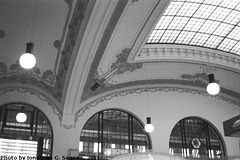
I don't the exact age of Dresden Neustadt, but it seems the station dates to the steam era. After all, relatively few stations this ornate were built once electrification started. There are some features that resemble stations on the New York Central, like New York Grand Central, Utica Union, and so on. The arched window and the skylight are the two things that I notice, although I assume it wasn't the same architect.
Bahnhof Dresden Neustadt, Picture 2, Edited Versio…
| |
|
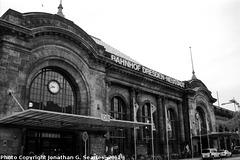
Here's the exterior. The distinctive lightning rods and the portals mark this as a German station (unless it's earlier, which is possible), but there are still features that resemble American stations, those arched windows, for example. Dresden Neustadt, in spite of not being the main Dresden station, is still quite busy, and I had a small brunch while I was here, since the passenger facilities are better than what you'd expect, too.
Dresden Hbf, Picture 3, Edited Version, Dresden, S…
| |
|
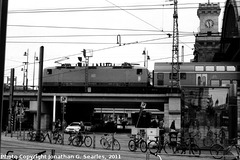
As usual, I took some train pictures in Dresden Hbf. This was one of my best, I think, composed with the bikes and all.
Synagoge Tram Stop, Picture 2, Edited Version, Dre…
| |
|
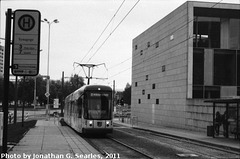
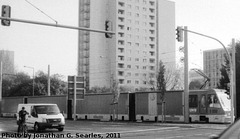
This may be out of chronological order with the Hbf shot, as it doesn't really make sense where this is on my list. In any case, this is the tram stop for the largest Synagogue in Dresden, seen on the right. It's actually a very well-equipped Synagogue, with sports facilities and so on, as well as this dedicated tram stop. The building isn't what it seems the first few times you look at it, as it has many interesting features hiding in plain view. For example, one portion of it (not visible here) is "twisted," in a not-so-obvious way, and it renaissance-style brickwork that you see here looks different depending on how close you are or what angle you're looking at it from. Needless to say, it doesn't look so Renaissance from every angle, as this is a thoroughly modern building. I didn't take this photo for the Synagogue, though. I just saw a tram coming, and took a couple of shots of the tram.
DVB Cargo Tram for VW, Cropped Version, Dresden, S…
| |
|
I see this large, articulated freight (auto-carrier?) tram nearly every time I visit Dresden, but I rarely get a good photo of it. This one's a compromise, being a crop. The tram appears to work for Volkswagen, moving new cars around.
Arriva Trains Wales #175006 in Cardiff Central Sta…
| |
|
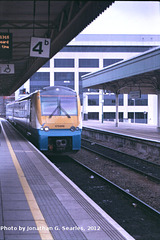
This is an Alstom (BR) Class 175 Coradia DMU. They were intended as a new generation of DMU that could operate at 125 m.p.h., although this was quickly downgraded to 110 and then to 100. 125 m.p.h. DMU's were eventually produced (in the form of the Virgin Voyager and BR Class 180), but the 175 Coradia never ended up filling such a role. Originally introduced in 2000 on First North Western, they have since been transferred to Arriva Trains Wales. Given the absurdity of the BR privatisation scheme, they have never been owned by a railway or Train Operating Company (TOC), but are instead owned by Angel Trains and leased to the TOC's, at much greater expense to the taxpayer. On this trip, I was on my way to Abergavenny for some hiking.
Arriva Trains Wales #175013, Abergavenny, Wales (U…
| |
|
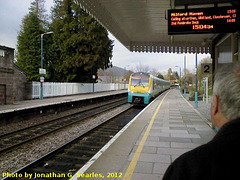
Here's another Coradia shot, but from the trip back. I got this one with my cameraphone.
Freightliner #70011 in Cardiff, Wales (UK), 2012
| |
|
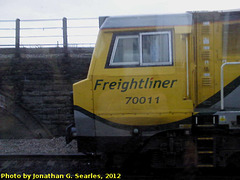
This was my first look at one of the new Class 70 freight diesels, this one working for Freightliner. Actually, these locomotives were already four years old when I took this, but I had been away from Britain for awhile so I hadn't been able to get a photo. They have several interesting facts about them, in addition to the usual specifications. First of all, they're made by General Electric, which would make them the first large order of G.E. diesels in British history, in spite of the popularity of G.E.'s in North America. Being completely authentic G.E.'s, they were built in Erie, PA, just like the Dash 8's I chased as a teenager. Secondly, they are perhaps the first BR class to reuse a previous class number, as 2 SR electrics and one Southern Region BR electric from the 1940's were considered Class 70 electrics under BR. 20 of these units are reported to have been built, although they aren't numbered sequentially, carrying the numbers 70001-70011 and 70013-70023 (Wikipedia says 70001-70011 and 70013-70020, but this makes no sense). There is also a demonstrator numbered 70099, and Freightliner's order is for 30 units, so more will likely be built. GBRf also have expressed interest in buying some of them. Their horsepower rating is 3,690, making them the most powerful diesels ever to be used in Britain (unless someone can correct me), and they are rated for a top speed of 75 m.p.h., which is typical for a G.E. freight diesel.
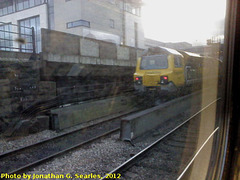
Freightliner #70011, Picture 2, Cardiff, Wales (UK…
| |
|
That last shot wasn't very good, and neither is this one, but here you can see the entirety of the locomotive a bit better. The unit caught me by surprise so I wasn't able to get the cameraphone awake fast enough to get a good shot.

Stodulky Metro Station, Stodulky, Prague, CZ, 2012
| |
|
This is the Stodulky Metro station, which is on the B Line and one of the newer ones, having been opened in 1994, after the fall of Communism.
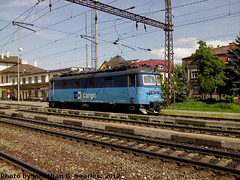
CD #123002-8 in Nadrazi Praha-Radotin, Radotin, Pr…
| |
|
This Class 123 electric, while very old (they were built in 1971, but were based on older designs from the 1950's), has now been transferred to CD Cargo, as you can see. In addition to its age, this transfer probably had to do with its 90 Km/h (56 m.p.h.) maximum speed, which is increasingly inadequate even for local passenger services.
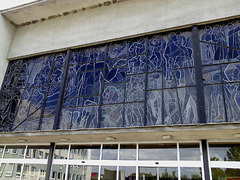
Stained Glass in Nadrazi Kladno, Kladno, Bohemia (…
| |
|
Many of the Communist-era ex-CSD stations have stained glass in them, much like earlier 20th-Century stations. This example is from Nadrazi Kladno.
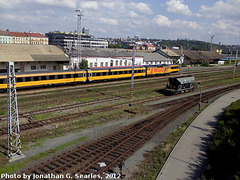
Regiojet Train in Praha-Smichov, Smichov, Prague,…
| |
|
In 2011, some intercity services were outsourced to Regiojet, a TOC owned and operated by the Student Agency, who had for a number of years run a bus service from Brno to London via Prague. I'm waiting to see what I really think of this, but I find it irritating that, supposedly, they don't take regular CD tickets, thus tying up train paths while offering a service (with their tickets) only a few times a day. It's the worst of both worlds in that regard. One of my colleagues praised this arrangement for encouraging competition, but this is a bit like praising competition between your doctor and your dentist in the same office, not in that their roles are the same, but in that if you see one you can't see the other, and if you need one you don't need the other. Competition in that case only makes it more difficult to get an appointment. Actually, the train is worse because you need it far more often.
Albion Dockyards, Bristol, England (UK), 2012
| |
|
|
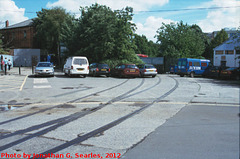
A lot of the Albion dockyards aren't open to the public even today, although there is some access because a lot of private boat owners dock nearby. While Albion handle far smaller boats and ships than in the past, they still do a fair amount of business in refitting. I don't know the status of these railway sidings, but the Bristol Docks Railway, now primarily a steam tourist railway, is nearby.
Bristol Docks Railway, Edited Version, Bristol, En…
| |
|
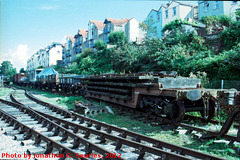
Like most ports, Bristol acquired extensive rail connections in the 19th Century, and many if not most of these remain today. Much of it is ex-Great Western, as Great Western controlled most of the original rail services in and out of Bristol. Even the Bristol & Exeter was eventually taken over by them. However, due to the port's decline (with much of this having to do with its inability to take the largest, newest ships), these rail lines have either become dormant or been included in the Bristol Docks Railway, a steam tourist railway that uses the lines into the port. When I visited, I didn't catch a train in steam, but I found some of the equipment in the yard. Unlike most rail facilities in the developed world, tourists and trains have to share some of the same space, as several of the tracks are embedded into the pavement of docks that are now pedestrianised for tourism. As a result, although I didn't spot any moving trains, I was constantly looking over my shoulder. I was standing on the tracks here, for example, but in the pedestrian area.

Bristol Docks Railway, Picture 2, Edited Version,…
| |
|
My sense was that the tourist rail route went back into the woods, but came out somewhere else. In any case, this line was clearly not open to the public, so I didn't follow it. Again, I was standing here in the pedestrian area.
Bristol Docks Railway, Picture 3, Edited Version,…
| |
|
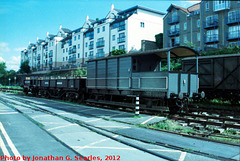
There was quite a lot of preserved freight equipment in the yard, here you can see a freight van on the right (a boxcar in American terms), a brake van (equivalent to a caboose), and a gondola. You can see some of the embedded track in the foreground.
Jump to top
RSS feed- Latest items - Subscribe to the latest items added to this album
- ipernity © 2007-2026
- Help & Contact
|
Club news
|
About ipernity
|
History |
ipernity Club & Prices |
Guide of good conduct
Donate | Group guidelines | Privacy policy | Terms of use | Statutes | In memoria -
Facebook
X
