


Scottish Highlands

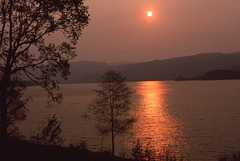
Sunrise over Loch Awe from Dalavich,Argyl May 1989
| |
|
|
|
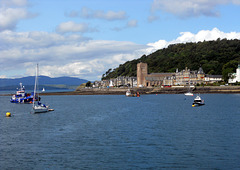
Oban Bay 22nd August 2013
| |
|
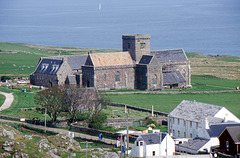
St.Columba`s Abbey,Iona 22nd May 1991
| |
|
Iona Abbey is located on the Isle of Iona, just off the Isle of Mull on the West Coast of Scotland. It is one of the oldest and most important religious centres in Western Europe. The abbey was a focal point for the spread of Christianity throughout Scotland and marks the foundation of a monastic community by St. Columba, when Iona was part of the Kingdom of Dál Riata. Iona Abbey is home to the Iona Community, an ecumenical Christian religious order, and remains a popular site of Christian pilgrimage today.
In 1899 the Duke of Argyll transferred ownership of the ruined remains of the Abbey and Nunnery sites to the Iona Cathedral Trust, which undertook extensive restoration of the Abbey church. In 1938, the inspiration of Reverend George MacLeod led a group which rebuilt the abbey, and founded the Iona Community. The reconstruction was organised by the architect Ian Gordon Lindsay having generously been passed the project from his senior mentor and friend Reginald Fairlie. The surrounding buildings were also re-constructed during the 20th century by the Iona Community. This ecumenical Christian community continues to use the site to this day.
The simple square font was added in 1908 and dedicated to the memory of the Very Rev Theodore Marshall DD, Moderator of the General Assembly of the Church of Scotland in that year.[8]
In 2000 the Iona Cathedral Trust handed over the care of the Abbey, Nunnery, and associated sites to Historic Scotland.
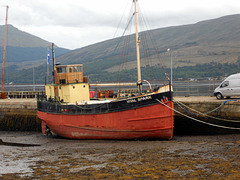
Clyde Puffer The Vital Spark at Iveraray 27th Augu…
| |
|
|
|
The Clyde puffer is a type of small coal-fired and single-masted cargo ship built mainly on the Forth and Clyde canal and which provided a vital supply link around the west coast and Hebrides islands of Scotland. Built between 1856 and 1939, these stumpy little steamboats achieved an almost mythical status thanks largely to the short stories Neil Munro wrote about the Vital Spark and her captain Para Handy, which produced three television series.
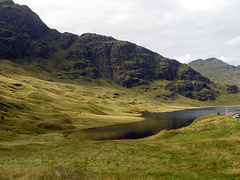
Loch Restil near The Rest and be Thankfull 27th Au…
| |
|
|
|
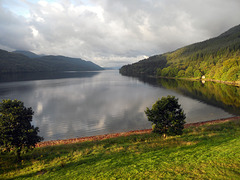
View of Loch Long from The Ardgartan Hotel 26th Au…
| |
|
|
|
Loch Long (Gaelic for Ship Lake, Long being the word for ship) is a body of water in Argyll and Bute, Scotland. The sea loch extends from the Firth of Clyde at its southwestern end. It measures approximately 20 miles (32 km) in length, with a width of between 1 and 2 miles (1.6 and 3.2 km). The loch also has an arm, Loch Goil, on its western side.
Loch Long was historically the boundary between Argyll and Dunbartonshire. However, in 1996 boundary redrawing meant that it moved wholly within the council area of Argyll and Bute.
The loch was used as a testing ground for torpedoes during World War II and contains numerous wrecks. It is now a popular area for sport diving. The Ardentinny Outdoor Education Centre also uses the loch for watersports.
Several Scottish sea fishing records are attributed to the loch:
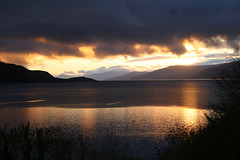
Sunset over Loch Linnhe from Onich 5th November 20…
| |
|
|
|
Sunset from Onich 5th November 2010
| |
|
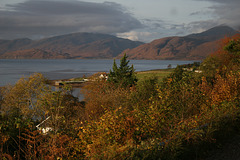
View across Loch Linnhe from Onich 1st November 20…
| |
|
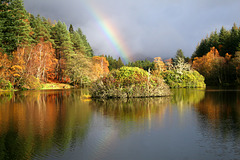
Rainbow Glencoe Lochan 5th November 2010
| |
|
|
|
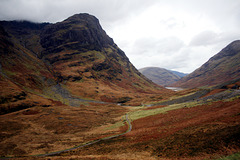
Glen Coe 1st November 2010
| |
|
|
|
Glen Coe (Scottish Gaelic: Gleann Comhann, pronounced [klan̪ˠˈkʰo.ən̪ˠ]) is a glen of volcanic origins, in the Highlands of Scotland. It lies in the north of Argyll, close to the border with Lochaber. It is often considered one of the most spectacular and beautiful places in Scotland, and is a part of the designated National Scenic Area of Ben Nevis and Glen Coe. The narrow glen shows a grim grandeur. The glen, approaching from the east on the main A82 road, is surrounded by wild and precipitous mountains. Further west at Invercoe, the landscape has a softer beauty before the main entrance to the glen. The main settlement is the nearby village of Glencoe located at the foot of the glen. near the site of the 1692 Massacre of Glencoe.
The Glen is named after the River Coe which runs through it. The name of the river is believed to predate the Gaelic language, and its meaning is not known. It is possible that the name stems from an individual personal name, Comhan (genitive Comhain).
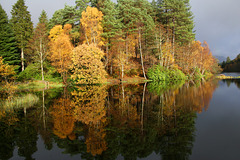
Autumn Reflections Glencoe Lochan 5th November 201…
| |
|
|
|
Glencoe Lochan is a tract of forest located just north of Glencoe village in the Scottish Highlands. It was planted/transplanted from the Pacific Northwest of Canada in the nineteenth century by Donald Alexander Smith, 1st Baron Strathcona and Mount Royal.
After acquiring the Glencoe Estate in 1895, Donald Alexander Smith and his wife, Isabella Sophia Hardisty, moved from Canada to Scotland. Soon after their arrival, Isabella became increasingly homesick for her ancestral lands in Canada. In an attempt to abate his wife's depression, Donald Alexander Smith had this forest painstakingly planted, and granted it to her as a private refuge. The lochan is currently under the care of the Forestry Commission, there are trails around it, parking and fishing for brown trout is possible with a permit purchased locally.
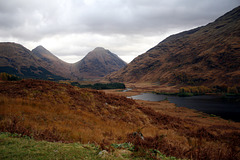
Autumn in Glen Etive 1st November 2010
| |
|
|
Glen Etive (Scottish Gaelic: Gleann Èite) is a glen in the Highlands of Scotland. The River Etive (Scottish Gaelic: Abhainn Èite) rises on the peaks surrounding Rannoch Moor, with several tributary streams coming together at the Kings House Hotel, at the head of Glen Coe. From the Kings House, the Etive flows for about 18 km, reaching the sea loch, Loch Etive. The river and its tributaries are popular with whitewater kayakers and at high water levels it is a test piece of the area and a classic run.
At the north end of Glen Etive lie the two mountains known as the "Herdsmen of Etive": Buachaille Etive Mòr and Buachaille Etive Beag. Other peaks accessible from the Glen include Ben Starav, located near the head of Loch Etive, and Beinn Fhionnlaidh on the northern side of the glen.
A narrow road from the Kings House Hotel runs down the glen, serving several houses and farms. This road ends at the head of the loch, though rough tracks continue along both shores.
The River Etive is one of Scotland's most popular and challenging white water kayaking runs. It provides a multitude of solid Grade 4(5) rapids with a variety of falls and pool drops.

Rainbow Loch Lomond from Luss 6th October 2006
| |
|
|
|

The CMD Arete with Sgurr a`Mhaim behind from Carn…
| |
|
|
|
For experienced, fit mountain walkers who do not mind easy scrambling but are not climbers, this is the finest way to climb Ben Nevis. This is a truly spectacular route incorporating two Munros. It will live long in the memory and does true justice to the mountain.
Carn Mor Dearg may be one of the highest mountains in Britain, but it is completely overshadowed by Ben Nevis. It is the perfect viewpoint from which to admire the Ben's magnificent North Face. Its graceful peak crowns a fine ridge - joined to its great neighbour by the celebrated Carn Mor Dearg arete.
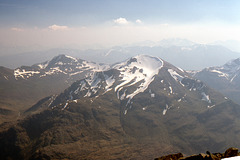
Sgurr a`Mhaim from Ben Nevis 1st May 1990
| |
|
|
|
Sgùrr a' Mhàim, (pronounced sgur-a-vam), is a Scottish mountain situated five and a half kilometres north north-west of Kinlochleven in the Lochaber region of the Highland area.
With a height of 1099 metres (3605 feet) Sgùrr a' Mhàim is a Munro and the second highest peak in the Mamores. It is a distinctive mountain being well seen up Glen Nevis from Fort William with its capping of quartzite stones catching the eye and giving it a light grey appearance which can be mistaken for a covering of snow. Surprisingly its Gaelic name gives no mention of these distinctive white rocks, being translated as "Peak of the large rounded hill". When viewed from Glen Nevis it looks like a great breast although the name can also be translated as "Peak of the Pass"
Sgùrr a' Mhàim is probably best known as the first or last peak of the “Ring of Steall”, a popular ridge walk taking in the other Munros of An Gearanach, Stob Coire a' Chàirn and Am Bodach. It is linked to the main spine of the Mamore group on its southern side by its most striking feature, The Devil’s Ridge, which is a one kilometre undulating ridge with a few exposed sections which require care. The most difficult part is (an avoidable rock gap) known as "The Bad Step" with well-known Scottish hill walker Hamish Brown The ‘Bad Step’ on the ridge is perhaps exaggerated - it can be jumped across. If you missed of course, a couple of bounces would land you down in the corries.
The Devil's Ridge has its own peak at the midpoint called Stob Choire a' Mhàil (990 metres) and then carries on to link to Sgor an Iubhair (Peak of the Yew; sometimes spelt Sgùrr an Iubhair), a 1001 m peak that briefly gained Munro status in 1981 only to lose it again in 1997. When viewed from the ridge Sgor an Iubhair looks every inch a separate distinctive mountain .Both the above peaks are listed as "tops" of Sgùrr a' Mhàim in the Munro Tables. Sgùrr a' Mhàim's northern side contrasts to its southern flank (where the Devil’s Ridge is). Caution is needed around the northern slopes as they drop steeply to Glen Nevis, here there are two fine corries which end abruptly in cliffs which fall steeply into the Nevis gorge.

Oban Bay 22nd August 2013
| |
|
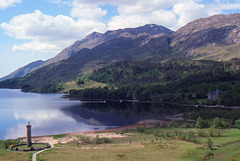
Loch Sheil at Glen Finnan 25th May 1989
| |
|
|
|
Loch Shiel (Scottish Gaelic: Loch Seile) is a 17 1⁄2 miles (28 km) long freshwater loch, 120 m (393 ft) deep, situated 12.4 miles west of Fort William in Lochaber, Highland, Scotland. Its nature changes considerably along its length, being deep and enclosed by mountains in the north east and shallow surrounded by bog and rough pasture in the south west, from which end the 4 km River Shiel drains to the sea in Loch Moidart near Castle Tioram.
Loch Shiel should not be confused with Glen Shiel, 40 km further north in Skye and Lochalsh, which contains a longer River Shiel and a much smaller Loch Shiel.
The surrounding mountains are picturesque but relatively rarely climbed as none quite reaches the 3,000 ft (910 m) required for Munro status. The area is well wooded compared to the many Highland areas that have suffered from overgrazing, and much of the shore is designated a Special Area of Conservation. Uniquely for a major loch[citation needed], the flow is not regulated. Boat trips for tourists have recently started on the loch.
Loch Shiel is only marginally above sea level and was in fact a sea loch a few thousand years ago when sea levels (relative to Scotland) were higher.
A ruined chapel can be found on the largest island said to be the first home on the Scottish mainland of St. Finan, a teacher of St. Columba. Acharacle, at the south of the Loch, is the site of the 1140 battle in which Somerled defeated the Norse to found the ruling dynasty of Lord of the Isles. During these times, the loch had strategic importance as a communications route through the mountains, as the short River Shiel was easily navigable in ancient times, however is no longer navigable as the depth drops to less than a foot. Alasdair mac Mhaighstir Alasdair, the poet and supporter of Bonnie Prince Charlie, was born and raised in the area. In 1745, after disembarking at Moidart, Bonnie Prince Charlie was rowed the length of the loch in order to raise his standard at Glenfinnan.
Loch Shiel is the location of the fictional Black Lake near Hogwarts in the film versions of the Harry Potter series. It is also the fictional birthplace of Connor and Duncan MacLeod from the Highlander franchise as well as the actual location of the boat scene with Ramirez in The Highlander (1986). The loch was also used in the filming of the movie The Master of Ballantrae starring Errol Flynn.
Jump to top
RSS feed- Latest items - Subscribe to the latest items added to this album
- ipernity © 2007-2026
- Help & Contact
|
Club news
|
About ipernity
|
History |
ipernity Club & Prices |
Guide of good conduct
Donate | Group guidelines | Privacy policy | Terms of use | Statutes | In memoria -
Facebook
X
