

David Holland's photos

5T2A8300-CR3 DxO DeepPRIME -1Mothv4
| |
Garden Rose Tortrix
Acleris variegana, Hutchinson's bank
From UK moths website
Wingspan 14-18 mm.
An extremely variable species which occurs commonly throughout Britain.
The larvae feed on rose (Rosa) bushes, as the name suggests, but also on a range of other trees and shrubs.
Flying from July to September, it is mainly nocturnal and is attracted by bright lights.

5T2A8296-CR3 DxO DeepPRIME -1Hoverflyv2

5T2A8290-CR3 DxO DeepPRIME -1Butterflyv3
| |
Holly Blue
Celastrina argiolus Hutchinson's bank
From UK Butterflies
The Holly Blue is primarily found in the southern half of the British Isles, and is a frequent visitor to gardens. This species is renowned for fluctuating wildly in numbers, forming a predictable cycle over a few years, believed to be caused by parasitism from the wasp Listrodromus nycthemerus whose sole host is the Holly Blue. The wasp lays its eggs in Holly Blue larvae, with a single adult wasp eventually emerging from the Holly Blue pupa. In England and Wales this species is widespread and common, south of a line running from Cumberland in the west to County Durham in the east. This species is also found on the Isle of Man and throughout Ireland, but is absent from Scotland except as a scarce vagrant.
(Bombus pascuorum), Hutchinson's bank

5T2A8257-CR3 DxO DeepPRIME -1flyv3
| |
Locust Blowfly
(Stomorhina lunata) Hutchinson's bank from Steve Falk
A very distinctive, House Fly-sized species with a strongly protruding lower face and striped thorax. Males have large orange patches on the sides of tergites 3 and 4 (=apparent tergites 2 and 3) but females only have grey dust patches here. The sexual dimorphism is similar to that of the Face Fly (Musca autumnalis) and it can sometimes be mistaken for that species or a hoverfly.
S. lunata is a highly mobile and migratory species that is being found increasingly frequently in Britain, though records extend to Sutherland
The larvae are known to develop as predators of locust egg pods abroad but are now thought to use grasshopper egg pods in Britain though it is unclear whether it forms permanent populations here. Adults visit the flowers of umbellifers, composites, mints etc.
The biology is summarised by Greathead (2009)
onlinelibrary.wiley.com/doi/10.1111/j.1469-7998.1962.tb01...
5T2A8252-CR3 DxO DeepPRIME -1Flyv3
| |
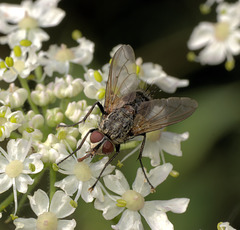
Estheria cristata (Garden Chafer Parasite Fly) Hutchinson's bank - I have never seen the host at Hutchinson's bank
From Steve Falk
A medium-sized (body length 8.5-10.5 mm) densely grey-dusted tachinid with bare eyes, a plumose arista and a short petiole (shortest than cross vein r-m) at the end of wing cell R4+5. The vibrissae are inserted well above the mouth edge, the jowls and parafacialia are very broad and eyes relatively small. There is no strong longitudinal ridge between the antennae in contrast to Dexia and Dinera species. The thoracic dorsum has four dark vittae and 3 pairs of postsutural dorsocentrals. The scutellum has a reddish ground colour. The abdomen has shifting dark markings. The legs are dark with brownish tibiae. The male frons is about one-eighth the head width, that of the female about two-fifths. The much rare E. bohemani is similar but has four pairs of postsutural dorsocentrals, a dark scutellum and the wing petiole about twice as long as cross-vein r-m.
E. cristata is a scarce species of southern Britain with records extending thinly north to Cumberland. It is found on dunes, downland and heathland. Adults fly in July and August and visit flowers such as ragworts, umbellifers and Yarrow. The larvae develop as internal parasitoids of the Garden Chafer Phyllopertha horticola.
NBN map:
species.nbnatlas.org/species/NBNSYS0000030055

5T2A8249-CR3 DxO DeepPRIME -1Tachnidv3
| |
|
Nowickia ferox Hutchinson's bank
Nowickia ferox is a univoltine species. Adults can be found from mid-June to October, with a peak from June to August. They fed on nectar and pollen, especially of Centaurea jacea.[5] Larvae develop in the dark arches moth (Apamea monoglypha)

5T2A8284-CR3 DxO DeepPRIME -1Tachnidv3
| |
|
Tachina ferox Hutchinson's bank
From Steve Falk
One of our most familiar tachinids, a medium-large (body length 10-14 mm), robust species with an orange abdomen bearing a conspicuous dark medium stripe (about one-quarter the width of the abdomen but variable) and a weak pattern of dusting on the thorax. Females have the legs (including all femora) orange with darker fore tarsi, but males have the femora black except the tips. The male frons is about one-quarter the head width, that of the female is about one-third, and the male frons rarely has any orbitals. The tarsi of all legs are generally orange throughout, and the front tarsi of females are clearly broadened. The male front and mid tarsi have the claws almost as long as the 4th and 5th tarsal segments combined. T. magnicornis is extremely similar but with much darker tarsi (the female fore tarsi not as broad as female T. fera), a broader frons (that of female about two-fifths the head width, that of male one-third or slightly more), the male frons with 1-3 proclinate orbitals and female femora black at the base.
T. fera is widespread and common, often the most conspicuous tachinid at a site. It occurs in a variety of habitats including woodland, wetlands, heathland. post-industrial sites, field margins and urban settings, especially where the vegetation is lusher. Adults fly from April to October and can be especially common in late summer and early autumn. They visit a tremendous range of flowers including spring-blossoming shrubs, umbellifers, mints, scabiouses, thistles, ragworts, knapweeds, goldenrods, Yarrow, Hemp Agrimony, Ivy and assorted garden Asteraceae and sedums. Hosts are noctuids including Ceramici pisi (Broom Moth), Cosmia trapezina (Dun-bar) and Orthosia cruda (Small Quaker).

5T2A8270-CR3 DxO DeepPRIME -1Conopidv2
| |
I think Conops quadrifasciatus, Hutchinson's bank The females of Conops quadrifasciatus specialise in attacking bumblebees in flight. They wait on flowers for a bumblebee to arrive and then hijack the bee and whilst holding on inject an egg into the bee's abdomen. The egg hatches inside the bee and the larva feeds on the bee's abdominal contents. The bumblebee eventually dies and the larva then pupates and emerges the following summer.

5T2A8258-CR3 DxO DeepPRIME -1Tachindv2
| |
|
Tachina ferox Hutchinson's bank
From Steve Falk
One of our most familiar tachinids, a medium-large (body length 10-14 mm), robust species with an orange abdomen bearing a conspicuous dark medium stripe (about one-quarter the width of the abdomen but variable) and a weak pattern of dusting on the thorax. Females have the legs (including all femora) orange with darker fore tarsi, but males have the femora black except the tips. The male frons is about one-quarter the head width, that of the female is about one-third, and the male frons rarely has any orbitals. The tarsi of all legs are generally orange throughout, and the front tarsi of females are clearly broadened. The male front and mid tarsi have the claws almost as long as the 4th and 5th tarsal segments combined. T. magnicornis is extremely similar but with much darker tarsi (the female fore tarsi not as broad as female T. fera), a broader frons (that of female about two-fifths the head width, that of male one-third or slightly more), the male frons with 1-3 proclinate orbitals and female femora black at the base.
T. fera is widespread and common, often the most conspicuous tachinid at a site. It occurs in a variety of habitats including woodland, wetlands, heathland. post-industrial sites, field margins and urban settings, especially where the vegetation is lusher. Adults fly from April to October and can be especially common in late summer and early autumn. They visit a tremendous range of flowers including spring-blossoming shrubs, umbellifers, mints, scabiouses, thistles, ragworts, knapweeds, goldenrods, Yarrow, Hemp Agrimony, Ivy and assorted garden Asteraceae and sedums. Hosts are noctuids including Ceramici pisi (Broom Moth), Cosmia trapezina (Dun-bar) and Orthosia cruda (Small Quaker).

IMG 5915-CR2 DxO DeepPRIME -1Beetlev3
| |
Beetle, The real size is 5.74 mm, magnification is 1.4 Hutchinson's bank
Complex Cryptocephalus sericeus
a member of Genus Cryptocephalus

IMG 5871-CR2 DxO DeepPRIME -1Beev3

IMG 5867-CR2 DxO DeepPRIME -1Beev3
| |
Bee The real size is 5.75 mm, magnification is 1.68 Hutchinson's bank
Maybe Bronze Furrow Bee
(Halictus tumulorum)

IMG 5856-CR2 DxO DeepPRIME -1Flyv4
| |
|
Locust Blowfly
Stomorhina lunata Fly, The real size is 5.81 mm, magnification is 1.4, from Hutchinson's bank
From Steve Falk
A very distinctive, House Fly-sized species with a strongly protruding lower face and striped thorax. Males have large orange patches on the sides of tergites 3 and 4 (=apparent tergites 2 and 3) but females only have grey dust patches here. The sexual dimorphism is similar to that of the Face Fly (Musca autumnalis) and it can sometimes be mistaken for that species or a hoverfly.
S. lunata is a highly mobile and migratory species that is being found increasingly frequently in Britain, though records extend to Sutherland
The larvae are known to develop as predators of locust egg pods abroad but are now thought to use grasshopper egg pods in Britain though it is unclear whether it forms permanent populations here. Adults visit the flowers of umbellifers, composites, mints etc.
The biology is summarised by Greathead (2009)
onlinelibrary.wiley.com/doi/10.1111/j.1469-7998.1962.tb01...

IMG 5850-CR2 DxO DeepPRIME -1Antv3

IMG 5844-CR2 DxO DeepPRIME -1Springtailv3
| |
|
Entomobrya multifasciata
a member of Slender Springtails Family Entomobryidae Springtail, The real size is 1.4 mm, magnification is 3.78 Ravensbourne Road, Bromley

5T2A8973-CR3 DxO DeepPRIME -1Beev3

5T2A8950-CR3 DxO DeepPRIME -1SpeckledWoodSpeckledW…

5T2A8832-CR3 DxO DeepPRIME -1Hoverflyv3
| |
|
|
|
