

Streetlife
Finestre dal Broletto
Hanging vases from the arch of Broletto
flowered balconies
Street life and street lamp
Flowers, windows, arches and terraces
Detail of the Santa Maria Assunta's church
Chiesa di Santa Maria Assunta
Little street and flowers near the church
From the Assunta church to the lake
Lane with bignonia
Isola di San Giulio
leaving Orta to the island
Sport around the San Giulio island
With the boat around the San Giulio island
A boat like our
Listen to the silence
Street lamp at the island
Street lamp on the way of silence
Garden at the island
bike and flowers
Old street
Street lamp in the old street
Embroidered gate
Monumento a Carl Heinz Schroth
Tetti di Orta
Orta -Villa Bossi - Town hall
Terrazzo ai giardini del municipio-Bignonia camps…
Giardini del municipio
Lane with nice balconies
Oratorio di San Rocco
Orta vintage
Porcelain
Milk and sugar
Tea house
Brusio spiral viaduct
Kreisviadukt von Brusio
Viadotto elicoidale di Brusio
Piz Palù
Swiss mountains -Bernina range
From the Bernina Express
From the Bernina Express-Morteratsch Glacier-Berni…
Squirrel on the lake
Ducks family
Sport on the lake
Location
Lat, Lng:
You can copy the above to your favourite mapping app.
Address: unknown
You can copy the above to your favourite mapping app.
Address: unknown
See also...
Keywords
Authorizations, license
-
Visible by: Everyone -
All rights reserved
-
261 visits
Palazzo della comunità o Broletto
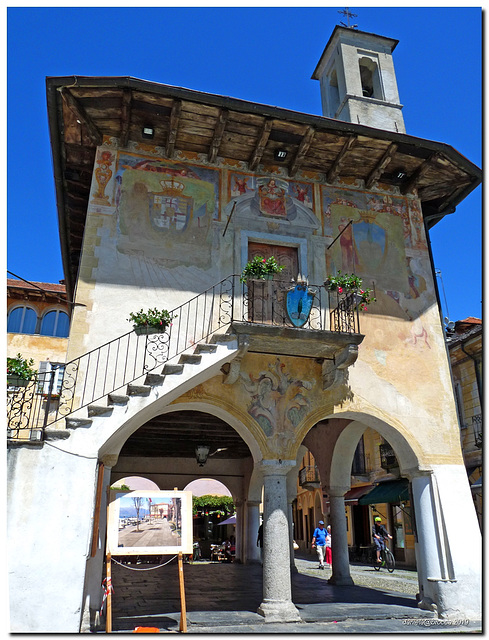

Situato in Piazza Motta, cuore dell'abitato di Orta, è sorto nel 1582; qui veniva esercitato dal Consiglio Generale (composto dai deputati del feudo vescovile) il potere legislativo, oltre che esecutivo, e può perciò essere considerato il simbolo del lungo autogoverno che caratterizzò la comunità della Riviera.
Una scaletta esterna collega l'ampio porticato alla grande unica sala del primo piano.
Le pareti esterne dell'edificio sono decorate con gli stemmi di alcuni vescovi di Novara che si succedettero nel governo della regione; la facciata a destra dell'ingresso riporta lo stemma di Orta, accompagnato dalla scritta "Hortus Conclusus", a sottolineare sia la collocazione geografica che l'autonomia della Riviera.
Il fatto che il palazzo fosse sede del potere legislativo ed esecutivo è evidenziato dalla presenza, sopra la porta, del dipinto di una"Donna raffigurante la Giustizia" con ai lati due angeli recanti la spada e la bilancia.
-------------------------------------------
Located in Piazza Motta, the heart of the town of Orta, it was founded in 1582; here was exercised by the General Council (composed of deputies of the bishopric) the legislative power, as well as executive, and can therefore be considered the symbol of long self-government that characterized the community of the Riviera.
An external staircase connects the large portico to the large single room on the first floor.
The external walls of the building are decorated with the coats of arms of some bishops of Novara who succeeded one another in the government of the region; the facade to the right of the entrance bears the coat of arms of Orta, accompanied by the inscription "Hortus Conclusus", to underline both the geographical location and autonomy of the Riviera.
The fact that the palace was the seat of the legislative and executive power is evidenced by the presence, above the door, of a painting of a "Woman representing Justice" with two angels on either side bearing the sword and the scale.
Translated with www.deepl.com/Translator
Una scaletta esterna collega l'ampio porticato alla grande unica sala del primo piano.
Le pareti esterne dell'edificio sono decorate con gli stemmi di alcuni vescovi di Novara che si succedettero nel governo della regione; la facciata a destra dell'ingresso riporta lo stemma di Orta, accompagnato dalla scritta "Hortus Conclusus", a sottolineare sia la collocazione geografica che l'autonomia della Riviera.
Il fatto che il palazzo fosse sede del potere legislativo ed esecutivo è evidenziato dalla presenza, sopra la porta, del dipinto di una"Donna raffigurante la Giustizia" con ai lati due angeli recanti la spada e la bilancia.
-------------------------------------------
Located in Piazza Motta, the heart of the town of Orta, it was founded in 1582; here was exercised by the General Council (composed of deputies of the bishopric) the legislative power, as well as executive, and can therefore be considered the symbol of long self-government that characterized the community of the Riviera.
An external staircase connects the large portico to the large single room on the first floor.
The external walls of the building are decorated with the coats of arms of some bishops of Novara who succeeded one another in the government of the region; the facade to the right of the entrance bears the coat of arms of Orta, accompanied by the inscription "Hortus Conclusus", to underline both the geographical location and autonomy of the Riviera.
The fact that the palace was the seat of the legislative and executive power is evidenced by the presence, above the door, of a painting of a "Woman representing Justice" with two angels on either side bearing the sword and the scale.
Translated with www.deepl.com/Translator
Pano ☼ Rapi ♫✯♫, Erhard Bernstein have particularly liked this photo
- Keyboard shortcuts:
Jump to top
RSS feed- Latest comments - Subscribe to the comment feeds of this photo
- ipernity © 2007-2026
- Help & Contact
|
Club news
|
About ipernity
|
History |
ipernity Club & Prices |
Guide of good conduct
Donate | Group guidelines | Privacy policy | Terms of use | Statutes | In memoria -
Facebook
X

Have a nice Sunday.
Daniela Brocca club has replied to Jaap van 't Veen clubDaniela Brocca club has replied to (´◡`) JohnNymer clubDaniela Brocca club has replied to Gudrun clubSign-in to write a comment.